Teaching
Teaching Assistant Positions
Department of Earth & Environmental Sciences, Columbia University
- Spring 2025: Introduction to Climate Systems
- Fall 2024: Science for Sustainable Development (*grader)
- Spring 2021: Introduction to Climate Systems
- Fall 2021: Geochemistry for a Habitable Planet (*grader)
Student Reviews:
Lead Teaching Fellowship
Center for Teaching and Learning, Columbia University (2025-2026)
Served as a Lead Teaching Fellow for the Earth & Environmental Sciences Department. In this role, I designed and ran pedagogical workshops for graduate students and acted as a liaison between my department and the Center for Teaching and Learning
Pedagogical Workshops
- Spring Workshop Teaching through Code: Designing Interactive Lessons in Jupyter Notebook
- Jupyter Notebook offers a versatile coding environment that can be used to create engaging lecture slides and in-class activities. The ability to mix expository text and/or images with small code blocks may also be used to encourage the development of student coding skills, particularly in homework assignments, while keeping class time focused on content. This pedagogical workshop focuses on designing lectures, activities, and assignments in Jupyter Notebook, with an emphasis on building students’ confidence working in coding environments. We will discuss how to structure a Notebook for optimal readability and engagement, how to leave detailed annotations such that code is accessible, and how to optimize widgets for live data visualization exercises and conceptual demonstrations.
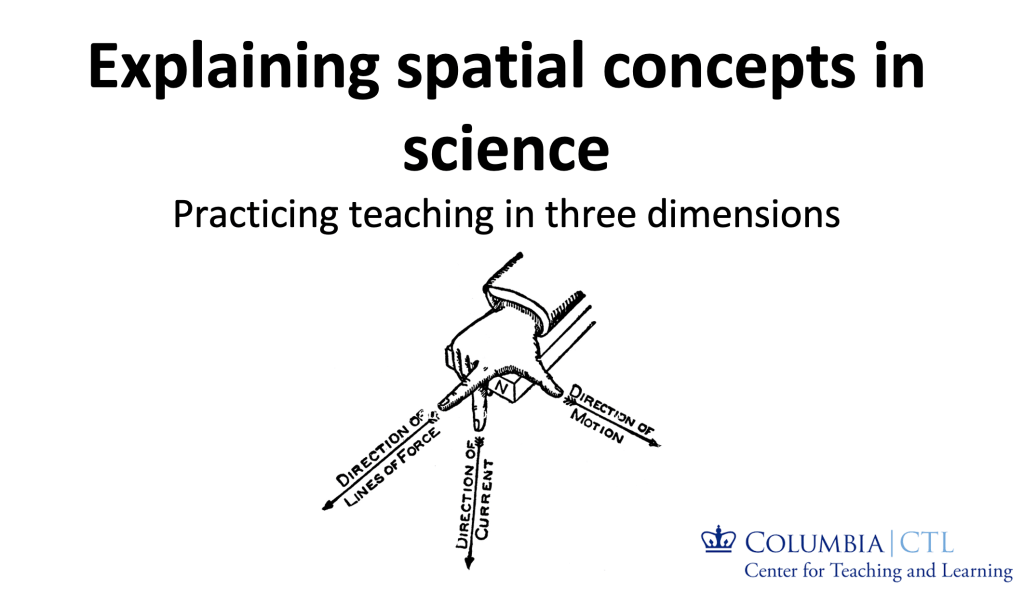
- Fall Workshop Explaining Spatial Concepts in Science
- Spatial visualization skills are critical for understanding foundational concepts in STEM. The ability to mentally rotate objects, or to see two dimensional schematics in three dimensional space, is often assumed of students in introductory undergraduate courses. This workshop is a collaborative discussion/brainstorming session for graduate TAs on how to best explain three-dimensional concepts to students who may be struggling with this type of thinking. We will start with a brief overview of common instructional strategies that promote spatial learning before breaking into small groups. Strategies reviewed will focus on making use of the limited resources typically available during office hours — our hands, metaphors and analogies, paper and pen, etc. Graduate students are invited to bring a concept from their field that relies on spatial thinking and to teach it to their peers.
Scientist-in-Residence Program
New York Academy of Sciences (NYAS) Scientist in Residence Program (2023-2024)
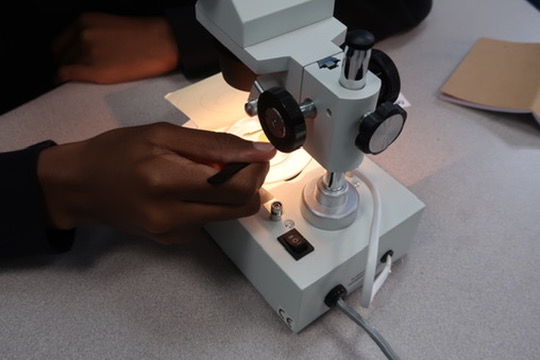
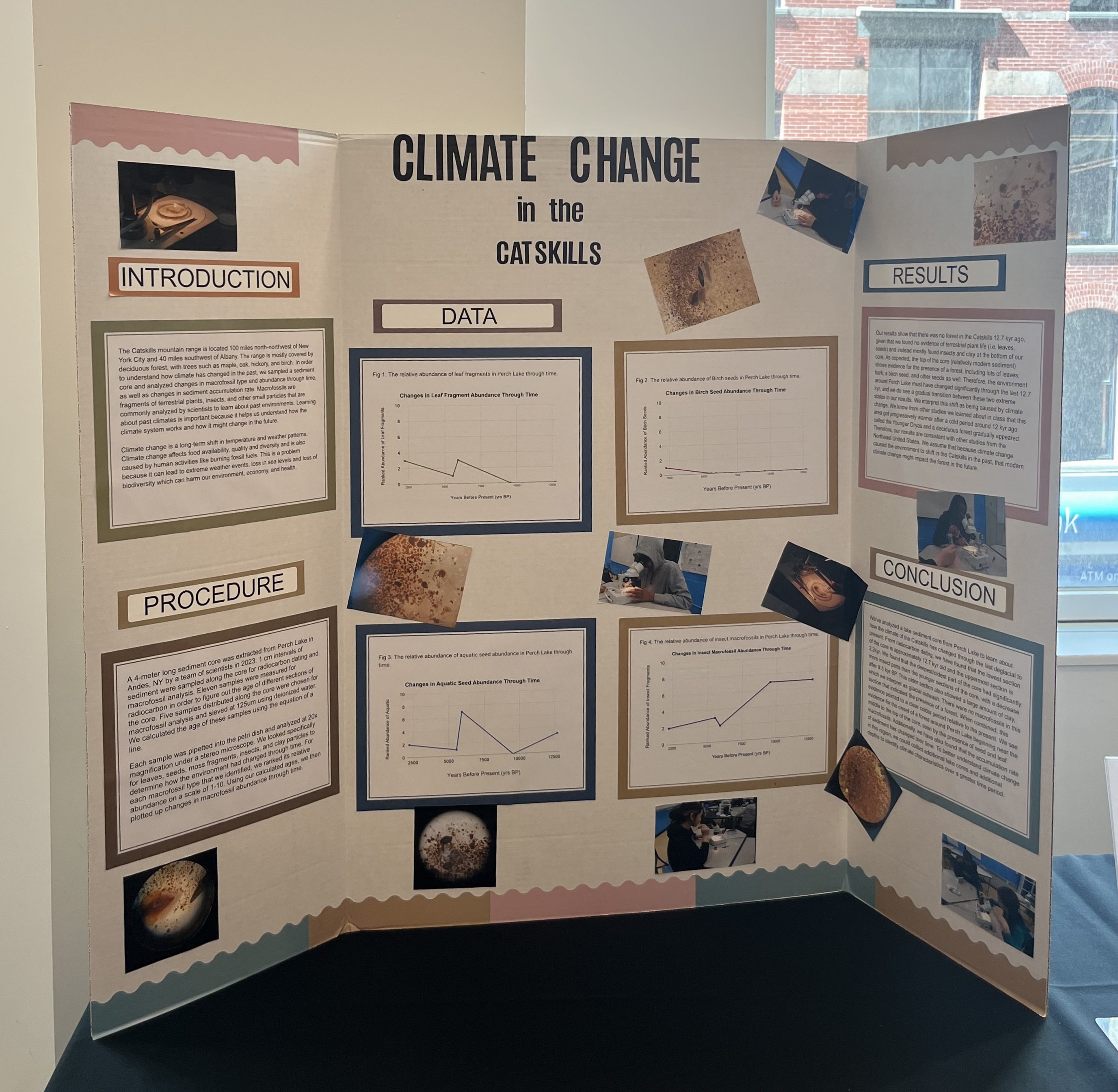
Designed a 10-week, hands-on research project for 9th grade students at New Visions Charter High School for Advanced Math and Sciences in the Bronx. Students picked and analyzed plant macrofossils from lake sediments in order to learn about Holocene climate change in New York State. Funding was used to purchase new stereomicroscopes for the school biology lab.
1-on-1 Chemistry Tutoring
Department of Chemistry, Columbia University (2022-2023)
- Organic Chemistry I, Organic Chemistry II, General Chemistry I, General Chemistry II
Center for Student Advising, Columbia University (2019-2020)
- Organic Chemistry I, Organic Chemistry II

